Publications

Research Spotlight

Akaliyski, P., Messner, W. (2026)
When AI thinks about culture: comparing language-based and empirical measures of individualism–collectivism
Journal of International Business Studies

2026


When AI thinks about culture: comparing language-based and empirical measures of individualism–collectivism

Akaliyski, P., & Messner, W.

Journal of International Business Studies

Abstract

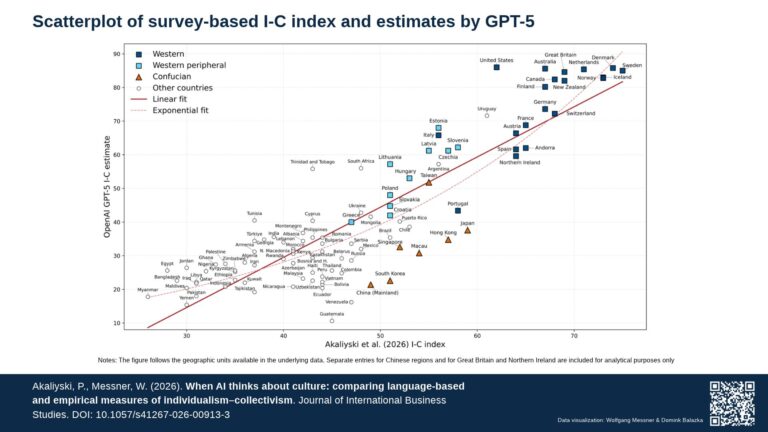
Large language models (LLMs) are increasingly used to generate cultural insights, yet little is known about their cultural expertise and the extent to which their outputs replicate or correct for cultural stereotypes. This study compares country-level estimates of individualism–collectivism (I-C) derived from five different LLMs with a recently validated I-C index based on nationally representative surveys. The LLM-based estimates correlate highly with the survey-based index (up to r = 0.874) but also exhibit systematic deviation from the benchmark: Western societies are consistently overestimated on individualism, while Confucian East Asian societies are underestimated. Statistically, the type of benchmark-relative deviations suggests group-specific baseline distortions rather than random noise, with smaller and older models showing weaker alignment. Moreover, the deviations are systematically aligned with Hofstede’s original I-C rankings, suggesting that LLM-generated cultural representations may reflect information from legacy cultural frameworks alongside contemporary empirical patterns. These findings demonstrate both the potential and the risks of using LLMs as cultural interpreters. In consequential settings, LLM-generated cultural insights should be used responsibly—with calibration, human oversight, and awareness of potential biases. Used uncritically, they risk reinforcing outdated narratives that misdirect academic research and managerial decisions.

The whole beyond the parts: a configurational analysis of cultural and institutional effects on innovation

Tamilina, L., & Akaliyski, P.

Economics of Innovation and New Technology

Abstract

Innovation is widely recognised as a fundamental driver of long-term economic and societal prosperity, prompting extensive research into its determinants. Although culture and formal institutions are increasingly acknowledged as critical antecedents of innovation, empirical evidence remains limited regarding how these factors combine to either facilitate or constrain national innovation performance. This study investigates the joint effects of individualism–collectivism and formal institutions on both low and high innovation. Using fuzzy-set qualitative comparative analysis (fsQCA) on a sample of 80 countries, we identify multiple configurations of cultural and institutional conditions associated with divergent innovation outcomes. Our findings indicate that innovation is shaped by asymmetric patterns of sufficiency between cultural and institutional factors. High innovation requires their joint presence, while low innovation can arise from multiple forms of institutional or cultural deficiency. Building on this asymmetric relationship, we propose a novel typology of national innovation regimes.

Demographic processes constrain global growth in gender egalitarianism

Akaliyski, P., Bowen, C.E., Gehrig, S., & Skirbekk, V.

PNAS Nexus

Abstract

Women’s and men’s equal participation in work, education, and politics rests upon widespread public support for gender equality. While notable increases in support for gender equality over the past decades have been celebrated, existing evidence is limited by a predominant focus on Western societies. Utilizing data from the World Values Survey and European Values Study covering 78 countries that represent >86% of the global population, we examine how population-level support for gender equality in the public sphere changed between 1995 and 2022, both globally and across different cultural and socioeconomic contexts. Our results indicate that, although public support for gender equality increased in most countries, it stagnated in the global population as a whole. Moreover, there has been a pronounced and increasing divergence across countries, particularly between Western and non-Western societies. We attribute part of the stagnation in global public support for gender equality to demographically induced compositional effects. Namely, we find that (i) changes in the national composition of the global population have constrained increases in global public support for gender equality; (ii) fertility is higher in countries where average support for gender equality is lower; and (iii) fertility is higher and occurs earlier among women with less egalitarian views. Given that parents typically transmit their gender-related views to their children, higher and earlier fertility among persons with less egalitarian views has likely constrained global growth in gender egalitarianism. We call for a closer examination of how demographic processes influence global trends in gender egalitarianism.

2025


Individualism–Collectivism: Reconstructing Hofstede’s Dimension of Cultural Differences

Akaliyski, P., Vignoles, V., Welzel, C., & Minkov, M.

Journal of Personality and Social Psychology

Abstract

Individualism–collectivism (I-C), the most widely researched cultural dimension, is often equated with Hofstede’s pioneering nation scores. Concerns are growing about these scores’ validity, but subsequent research has not produced a widely accepted alternative. Here, we offer a refined theoretical conceptualization of I-C, we systematically reevaluate the validity of Hofstede’s I-C scores, and we report the development and validation of a new I-C index, covering 102 countries/territories inhabited by an estimated 88% of the world’s population. In Study 1, we document the inferior convergent and nomological validity of Hofstede’s I-C index, compared to subsequent measures. Hofstede’s scores substantially overestimate individualism in English-speaking countries and collectivism in East Asian societies, which we demonstrate can considerably bias research findings. In Study 2, we develop an authoritative, theory-driven I-C index, using nationally representative data from the World Values Survey and European Values Study, which shows excellent internal coherence, temporal stability, and strong evidence of convergent, discriminant, and nomological validity. Theorized facets of individualism—freedom (vs. conformity), tolerance of differences (vs. exclusion), and equality (vs. discrimination)—form a coherent and stable dimension at the cultural level of analysis. Individualism is higher in societies with better existential security (e.g., socioeconomic development, stable institutions) and is not associated with greater selfishness, anomie, or competitive beliefs and values. Relying on outdated indices may perpetuate cultural stereotypes and underpin flawed theorizing. Scholars should use theoretically appropriate and up-to-date measures of societal culture when seeking to understand global variation in human psychological functioning.

The nature and utility of cultural tightness–looseness: evidence for reconsideration

Minkov, M., Akaliyski, P., Kaasa, A., & Welzel, C.

Journal of International Business Studies

Abstract

Numerous studies focus on the tightness–looseness (TL) dimension of national culture, reporting important implications for business and management. However, the main TL measure has generated a number of theoretical and empirical concerns. It likely reflects unfounded national auto-stereotypes, the conceptual boundary between TL and individualism–collectivism (IC) is blurred, respondents in different societies have different TL-related concepts, and TL yields mostly low and often insignificant correlations with its presumed correlates. Using the latest TL data from Eriksson, Gelfand, and associates, we find that some TL items are uncorrelated with aggregates of corresponding self-reports. TL is not predicted by its main presumed antecedents, and has marginal or no effects on its presumed main consequences, including all metanorms (reported frequencies of reactions to inappropriate behavior). Our results challenge the validity of measures of culture based on respondents’ generalized impressions of their compatriots. We suggest a revision of TL theory in which much of the TL concept can be subsumed under IC. We highlight the fact that a society can be tight in one domain and loose in another, which depends largely on its IC position.

The main global cultural differences today evolved from environment-related historical agricultural patterns

Minkov, M., Akaliyski, P., & Kaasa, A.

World Development

Abstract

Decades of research have demonstrated that many cultural differences between modern nations are associated with a single dimension of culture, called “individualism-collectivism” (IDV-COLL) or various other terms (including Schwartz’s “embeddedness”), contrasting Northwestern Europe plus the English-speaking countries with countries at low geographic latitudes. IDV cultures are characterized by greater individual freedom (especially reproductive and religious), rule of law, and human rights than COLL ones. Despite a partial worldwide shift toward IDV, these country differences are relatively stable. Previous research explains them as a function of differences in wealth, climate, pathogen prevalence, Western Church policies, and more. We test a new theory: prevalent types of agriculture 100 years ago and earlier still explain IDV-COLL differences. We analyze two strongly correlated IDV-COLL versions, by Minkov-Kaasa and by Schwartz, as well as a new measure of objective COLL-IDV for 84 nations, consisting of household size, gender inequality, LGBT rights, and rule of law. We also use the Minkov-Kaasa IDV-COLL index for the 50 US states. For all national IDV-COLL/COLL-IDV measures, across the whole country sample, and across 35 culturally independent nations (thus avoiding autocorrelation), historically prevalent dairy farming is associated with IDV, whereas nomadic herding and shifting cultivation are associated with COLL. Across 48 US states, historically prevalent dairy farming predicts IDV, plantations predict COLL. Agriculture always produces the strongest direct effects. The effects of the other predictors are inconsistent, with the seeming exception of wealth. Yet, some environmental predictors have a distal effect on IDV-COLL, mostly through the mediation of agricultural types.

Individual’s psychology and society’s culture

Akaliyski, P., Vignoles, V., & Minkov, M.

In S. Liu, A. Komisarof, H. Zhu, & L. Obijiofor (Eds.), The Sage handbook of intercultural communication

New developments in Hofstede’s individualism-collectivism: A guide for scholars, educators, trainers, and other practitioners

Komisarof, A., & Akaliyski, P.

International Journal of Intercultural Relations

Abstract

Introduced as a measure by Geert Hofstede in 1980, the cultural dimension of Individualism-Collectivism (“I-C”) has dominated the field of cross-cultural research and guided intercultural trainers, educators, and other practitioners up to the present. In 2023, The Culture Factor, the global cultural analytics and strategy advisor company associated with Hofstede’s framework, updated their I-C scores due to mounting concerns with Hofstede’s operationalization and measurement of I-C, specifically over its old and non-representative data, as well as its limited face and content validity. These newer I-C scores are derived from the work of Hofstede’s former collaborator, Michael Minkov, and are based on two distinct datasets: a 2015 Hofstede Insights survey covering 55 countries and the World Values Survey covering 47 more, for a total of 102 countries/regions. Conceptually, the model redefines I-C as consisting of three facets: conformism, social ascendancy, and exclusionism. We discuss three major sources of country-level scores associated with Hofstede’s name that pertain to his cultural dimensions, present a synthesized overview of the new developments in understanding and measuring I-C as it pertains to Hofstede’s work, and examine the suitability of both Hofstede’s original work and Minkov’s subsequent revisions to I-C for academic research, intercultural training, and education. Our article concludes with recommendations to (1) rigorously scrutinize the construction of cultural dimensions—in this case I-C—by critically assessing their validity, data sources, and methodologies; (2) validate these dimensions against external evidence; and (3) continue refining I-C measures by emphasizing reliable, representative data and stringent methodological validation.

Development, institutions, and identity: Reshaping Europe’s post-Cold War moral landscape

Akaliyski, P., & Tormos, R.

Journal of Cross-Cultural Psychology

Abstract

Post–Cold War Europe has become a scene of a grueling contestation over questions of morality, with key players being the EU and Russia. The legacy of the Cold War on the moral beliefs of European nations and their transformation over the last three decades requires an examination. We advance theory toward the potential role of development, institutions, and identity, associated with the Cold War division and continued differentiation at present. We use the Morally Debatable Behaviors Scale fielded in the World Value Survey and the European Values Study (1981–2021) to analyze the variation in the long-term dynamics of two moral dimensions: (a) dishonest-illegal issues (DII) and (b) personal-sexual issues (PSI). An age-period-cohort analysis reveals that old EU-members, post-communist EU-members, and post-communist non-EU countries have experienced distinct evolutions in both moral domains. The identity approach was supported: old EU members have increased their leniency on PSI and decreased it on DII; new EU members followed the same trends but slower on PSI and faster on DII; non-EU nations experienced no change on either issue. These trends are only partly attributable to the changes in the quality of institutions. Economic development has the expected positive effect only in old EU members, while its impact on PSI dwindles and even reverses as one moves away from Brussels’ sphere of influence. Furthermore, contrary to previous evidence, we find that economic development predicts changes in DII, potentially due to the expansion of moral concern to unknown others.

Non-Independence of Nations: Revisiting a Centuries-Old Methodological Challenge

Akaliyski, P., & Sng, O.

Cross-Cultural Research

Abstract

We revisit a critical problem of cross-cultural research: the non-independence of nations arising from shared ancestry and joint cultural diffusion. Recent review highlighted that few published cross-cultural studies attempt to control for such non-independence, often doing so inefficiently. This may compromise causal claims derived from such analyses. We reassess the problem and caution against using a one-size-fits-all “remedy” for non-independence. Non-independence can involve three distinct issues—(1) confounding by (un)observable variables, (2) Galton’s problem (joint diffusion and shared ancestry) as a special case of confounding, and (3) non-independence as a nuisance—each requiring a careful assessment of the causal model and a specific treatment. Controlling for non-independence by default may result in one of five outcomes, including successful elimination of the bias, improving precision, doing nothing, harming precision, or introducing bias, which we demonstrate with simulations. Instead of rolling a five-sided dice, we encourage cross-cultural scholars to begin with a careful evaluation of their underlying theoretical assumptions and causal models. In essence, we contribute to the refinement of cross-cultural research methodology by advocating for a tailored approach to addressing non-independence that models the real-world processes under examination.

2024


Comparative culturology and cross-cultural psychology: How comparing societal cultures differs from comparing individuals’ minds across cultures

Minkov, M., Vignoles, V. L., Welzel, C., Akaliyski, P., Kaasa, A., Bond, M. H., & Smith, P.

Journal of Cross-Cultural Psychology

Abstract

Cross-cultural research in social and behavioral sciences has expanded hugely over the past 50 years, but progress is currently hampered by a lack of appreciation of the profoundly differing principles and goals of two distinct traditions. The first is the main variant of cross-cultural psychology (CCP), focusing on how culture shapes individual psychological functioning. The second was pioneered by Hofstede. It studies societal differences, and we name it “comparative culturology” (CC). We explain how these two paradigms differ. CCP is grounded in psychology and typically looks for unobservable individual-level constructs, which supposedly exist independently of their measurement, to provide understanding of individual differences as affected by culture. CC is an interdisciplinary field whose roots and impact span sociology, anthropology, political science, economics, management studies, psychology, and beyond. CC measures cultural dimensions as group-level constructs created by researchers, which are best understood as ecological manifolds: conglomerates of conceptually and statistically associated variables (not necessarily held together by a single underlying factor) that collectively explain national (and other group) differences. Given these paradigmatic distinctions, the two fields need not, and cannot, use the same validation methods. They should co-exist and collaborate based on mutual appreciation of their differences, without attempts by either field to impose its idiosyncrasies on the other.

Ukrainian values: Between the Slavic-Orthodox legacy and Europe’s allure

Akaliyski, P., & Reeskens, T.

European Societies

Abstract

An important question in understanding the war in Ukraine is whether Russian President Putin’s claim that Russians and Ukrainians are ‘one people’ or whether the statement made by European Union Commission President von der Leyen, echoing Ukrainian government’s position, that Ukraine is ‘one of us’ receives more support. In our contribution, we assess the societal values endorsed in Ukraine, and test whether they resemble those of Russia or Western Europe. After reviewing arguments brought by the ‘Clash of Civilizations’, Modernization, Social Identity, and Nation Building theories, we analyze the most recent data from the European Values Study and World Values Survey (2017-2021). Constructing an EU-values index, including gender equality, individual freedom, and liberal democracy, among others, we show that while values in Ukraine are closer to Russia than virtually any European Union country, there are clear differences that are especially salient among younger age cohorts. Further, we refute Huntington’s claim that Ukraine is a ‘cleft’ country by showing that regional variation within Ukraine is rather minimal. We conclude with an interpretation of these findings in light of political debates and prominent theoretical approaches to studying values.

2023


Distinct conceptions of freedom in East Asia and the Protestant-West underpin unique pathways to modernity

Akaliyski, P.

Journal of Cross-Cultural Psychology

Abstract

Western theories of modernization and cultural change suppose that socioeconomic development fosters support for freedom and equality in all societies. Cultural relativism and “Asian Values” thesis challenge such theories of universal human development by arguing that East Asian societies’ cultural legacies predispose them to a distinct pathway of cultural and societal development. This study uses nationally representative data from the World Values Survey and European Values Study to test whether East Asian and hystorically Protestant Western societies hold six domains of freedom aspirations as strongly as their level of socioeconomic development predicts. Protestant Western nations score consistently high on all freedom aspirations, while East Asia’s scores are higher than predicted for personal autonomy and secular identity but lower for the other four domains: individual freedom, gender equality, political liberalism, and ethnic tolerance. Multidimensional scaling reveals clearly distinguishable Protestant Western and East Asian cultural models. The dimensions these models are depicted by are associated with various salient societal outcomes. East Asia’s emphasis on personal autonomy and secular identity is compatible with good physical and mental health, low crime, competitive economy, and educational achievements. Protestant West’s support for other aspects of freedom is associated with high subjective well-being, demographic sustainability, human rights and rule of law, democratic institutions, and gender equality. Convergence in cultural and societal development may not be expected in the foreseeable future.

Values in crisis: Societal value change under existential insecurity

Akaliyski, P., Taniguchi, N., Park, J., Gehrig, S., & Tormos, R.

Social Indicators Research

Abstract

The COVID-19 pandemic has had a profound impact on societies, with possible consequences for their fundamental values. Inglehart’s revised modernization theory links societal values to the underlying subjective sense of existential security in a given society (scarcity hypothesis), while also claiming that influences on values diminish once individuals reach adulthood (socialization hypothesis). An acute existential crisis such as the COVID-19 pandemic offers a rare opportunity to test these assumptions. We analyze data from representative surveys conducted in Japan shortly before and after the onset of the pandemic. Remaining survey sample differences are statistically controlled via propensity score weighting and regression adjustment, while post-stratification weights allow conclusions about the Japanese population. In three sets of analyses, we reveal that the pandemic and the experienced psychological distress are negatively associated with emancipative and secular values, entailing a reversal to traditionalism, intolerance, and religiosity. First, we document a substantial decline in both emancipative and secular values in the first months of the pandemic compared to five months earlier. This decline remained stable a year later. Second, we find that value change was stronger in prefectures more severely affected by the pandemic. Third, individuals who experienced higher psychological distress emphasized the same values more strongly, as evident in two surveys from May 2020 and April 2021. In contrast to the socialization hypothesis, our study provides evidence that, under extraordinary environmental conditions, values can shift even within a negligibly short time period.

2022


‘Harsh’ culture, alcoholism, climate, and social hardship explain national differences in suicide rates

Minkov, M., Kaasa, A., Akaliyski, P., & Schachner, M.

Comparative Sociology

Abstract

Suicide is a major cause of death in Central and Northeast Europe and Northeast Asia. The literature on this geographic pattern has not reached consensus. The authors propose an analysis of the view that national culture may be a risk factor. They use measures of culture from a quasi-nationally representative 2015–2016 database, with over 50,000 respondents from 53 countries, and WHO suicide data for 2016. A correlation analysis across items reveals four cultural features of countries with high suicide rates (r with suicide rates > .40): parents are less likely to socialize children for helping, sharing money, forgiving offenses, and expressing feelings. These four items yield a single “harshness” factor (r with national suicide rates = .69). Measures of self-construals reveal that people in countries with high suicide rates are less helpful, generous, and forgiving, have less interest in others, lower personal stability, poorer mood, lower self-esteem and self-confidence, and use less deliberation before important decisions (r with suicide rates > .40). These items yield another “harsh culture” factor, strongly correlated with the previous. Harsh culture, alcoholism rates, climatic harshness, and social hardship (short life expectancy plus child and maternal mortality), explain 71 percent of the national variation in suicide.

Flexible societies excel in saving lives in the first stage of the COVID-19 pandemic

Li, J., Akaliyski, P., Heisig, J. P., Löbl, S., & Minkov, M.

Frontiers in Psychology

Abstract

Background: Previous studies have shown that national cultural traits, such as collectivism–individualism and tightness–looseness, are associated with COVID-19 infection and mortality rates. However, although East Asian countries have outperformed other countries in containing COVID-19 infections and lowering mortality in the first pandemic waves, no studies to date have examined flexibility-monumentalism, a cultural trait that uniquely distinguishes East Asia from the rest of the world. Moreover, none of the previous studies have explored mechanisms underpinning the association between national culture and COVID-19 mortality.

Aims: Our study fills in these gaps by examining the association between flexibility-monumentalism and COVID-19 mortality, adjusting for important covariates and by analyzing mask wearing and fear of COVID-19 during the first weeks of the pandemic as plausible mechanisms underpinning this association.

Methods: We constructed and analyzed a dataset including 37 countries that have valid information on flexibility-monumentalism, COVID-19 deaths as of 31 October 2020 (before the start of vaccination campaigns), and relevant covariates including two other national cultural traits (individualism–collectivism and tightness–looseness) and other national characteristics (economic, political, demographic and health). Multiple linear regression with heteroscedasticity-consistent standard errors was used to assess the independent effect of flexibility-monumentalism on COVID-19 mortality. Mediation was assessed by examining the indirect effects of flexibility through mask wearing and fear of COVID-19 and determining the statistical significance through bootstrapping. Graphical and delete-one analysis was used to assess the robustness of the results.

Results: We found that flexibility was associated with a significant reduction in COVID-19 mortality as of 31 October 2020, independent of level of democracy, per capita GDP, urbanization, population density, supply of hospital beds, and median age of the population. This association with mortality is stronger and more robust than for two other prominent national cultural traits (individualism–collectivism and tightness–looseness). We also found tentative evidence that the effect of flexibility on COVID-19 mortality may be partially mediated through mask wearing in the first weeks of the pandemic.


The weight of culture: Societal individualism and flexibility explain large global variations in obesity

Akaliyski, P., Minkov, M., Li, J., Bond, M. H., & Gehrig, S.

Social Science & Medicine

Abstract
Background: Obesity rates have been rising steeply across the globe in recent decades, posing a major threat to global human health. Despite this almost universal increase, differences between countries remain striking, even among equally developed societies.

Methods: We test if two cultural dimensions derived from a revised Hofstede model of culture from Minkov (2018), namely collectivism vs. individualism and monumentalism vs. flexibility, could help explain national variations in prevalence of obesity (BMI ≥ 30) among women and men around the world. We develop a theoretical framework that links these two cultural dimensions with obesity and then test their association empirically in analyses including 51 countries from all regions of the world as well as using imputed data for a total of 155 countries, representing 98% of the global population.

Results: In contrast to previous studies, we find that, adjusting for undernourishment and other potential confounds, individualism is associated with higher obesity prevalence in the male population, but not among the female population. We explain these findings by pointing to the different mechanisms through which individualism relates to health behavior, some of which are more gender-specific than others. A further novel finding is that flexibility, a national cultural trait that emphases humility, self-control, and restraint of desires, is a strong negative predictor of obesity in both genders beyond various potential confounds and is highly robust in specification curve analyses.

Conclusions: Our findings suggest that taking national culture into account can enhance our understanding of the obesity pandemic and should thus be considered by policy-makers in their design of interventions.


2021


Convergence of political values? A multi-level analysis of developments in 18 EU countries 1990–2017

Van Houwelingen, P., Akaliyski, P., Iedema, J., & Dekker, P.

Comparative European Politics

Abstract

Basic core political values differ widely across Europe. From a European integration perspective, a gradual convergence in core political values across European countries would be beneficial. Desirably, the direction of any possible European value convergence would be also in accordance with the values stipulated by the European Union (EU). Based on European Values Study (EVS) data from 1990 to 2017, we assess the developments among 18 EU countries with regard to public opinion on nine political value indicators, comprising three core political values: equality, individual autonomy, and cosmopolitanism. The differences and the dynamics of change in core political values between these 18 European countries are considerable. Our investigation arrives at contradictory conclusions about the outcome of the temporal development, depending on the political value we analyze. EU countries have converged on equality and cosmopolitanism values, but diverged on individual autonomy. The overall change in cosmopolitanism is, however, not in the direction the EU intends, as the countries have become more skeptical of EU enlargement. The trend in individual autonomy is in an EU-desired direction (‘same direction’), but is much slower in the former socialist countries (‘different speed’), which results in divergence on an EU-wide scale.

On ‘nationology’: The gravitational field of national culture

Akaliyski, P., Welzel, C., Bond, M. H., & Minkov, M.

Journal of Cross-Cultural Psychology

Abstract

Nations have been questioned as meaningful units for analyzing culture due to their allegedly limited variance-capturing power and large internal heterogeneity. Against this skepticism, we argue that culture is by definition a collective phenomenon and focusing on individual differences contradicts the very concept of culture. Through the “miracle of aggregation,” we can eliminate random noise and arbitrary variation at the individual level in order to distill the central cultural tendencies of nations. Accordingly, we depict national culture as a gravitational field that socializes individuals into the orbit of a nation’s central cultural tendency. Even though individuals are also exposed to other gravitational forces, subcultures in turn gravitate within the limited orbit of their national culture. Using data from the World Values Survey, we show that individual values cluster in concentric circles around their nation’s cultural gravity center. We reveal the miracle of aggregation by demonstrating that nations capture the bulk of the variation in the individuals’ cultural values once they are aggregated into lower-level territorial units such as towns and sub-national regions. We visualize the gravitational force of national cultures by plotting various intra-national groups from five large countries that form distinct national clusters. Contrary to many scholars’ intuitions, alternative social aggregates, such as ethnic, linguistic, and religious groups, as well as diverse socio-demographic categories, add negligible explained variance to that already captured by nations.

A community of shared values? Dimensions and dynamics of cultural integration in the European Union

Akaliyski, P., Welzel, C., & Hien, J.

Journal of European Integration

Abstract

The series of recent crises (EURO, refugees, backsliding, Brexit) challenge the self-portrayal of the European Union (EU) as a community of shared values. Against this backdrop, we analyse European Values Study data from 1990 till 2020 to assess the level and change in publics’ acceptance of the EU’s officially propagated values: personal freedom, individual autonomy, social solidarity, ethnic tolerance, civic honesty, gender equality and liberal democracy. We find that EU publics support these values strongly and increasingly over time. The EU-member publics are also remarkably distinct culturally from Eastern European non-EU-nations, especially concerning individual freedoms and gender equality. Simultaneously, however, member nations internalize EU-values at different speeds – alongside traditional religious fault lines that continue to differentiate Europe – in the following order from fastest to slowest: (1) Protestant, (2) Catholic, (3) Ex-communist and (4) Orthodox countries. In conclusion, the EU writ large evolves into a distinct value-sharing community at different speeds.

2020


Clashing values: Supranational identities, geopolitical rivalry and Europe’s growing cultural divide

Akaliyski, P., & Welzel, C.

Journal of Cross-Cultural Psychology

Abstract

Soon after the collapse of Soviet-type communism in Central and Eastern Europe, a new geopolitical division began to reshape the continent. Our study demonstrates that this newly emerging geopolitical divide has been underpinned by a corresponding cultural divergence, of which “emancipative values” are the most powerful marker. Using the European Values Study/World Values Survey 1990 to 2014, we find that the former Iron Curtain no longer constitutes a cultural boundary because the ex-communist states that joined the European Union have been converging with the West’s strong emphasis on emancipative values. Instead, a new and steeply growing cultural gap has emerged between the European Union and its Eastern neighbors. The two competing geopolitical formations in the West and East—the European and Eurasian Unions, respectively—have diverged culturally in recent decades. The divergence goes back to contrasting supranational identities that originate in different religious traditions, which rulers have increasingly accentuated to strengthen their nations’ endorsement or dismissal of emancipative values. Through this sorting-out process, emancipative values became an increasingly significant marker of a Western-vs-Eastern cultural identity. Our study is the first to link this groundbreaking cultural transformation to civilizational identities and geopolitical rivalry.

2019


United in diversity? The convergence of cultural values among EU member states and candidates

Akaliyski, P.

European Journal of Political Research

Abstract

The European Union (EU) is considered to be a unique economic and political union that integrates most European countries. This article focuses on the cultural aspect of European integration, which has been increasingly debated over the course of deepening and widening integration and in the context of the legitimation crisis of the EU. Among the main goals of the EU is to promote certain values, which raises the question of whether it has been efficient in (or enabled) reducing cultural value gaps among the participating countries. World polity and institutional isomorphism theories suggest that cultural values may trickle down in a vertical manner from the institutions of the EU to its member states and candidates. Furthermore, hybridisation theory postulates that values diffuse horizontally through intensified interactions enabled by the EU. These two perspectives imply the possibility of cultural convergence among countries associated with the EU. By contrast, the culture clash thesis assumes that differences in cultural identity prevent value convergence across countries; growing awareness of such differences may even increase the pre‐existing cultural value distances. To test these different scenarios, distances in emancipative and secular values are compared across pairs of countries using combined repeated cross‐sectional data from the European Values Study and the World Values Survey gathered between 1992 and 2011. This study finds that the longer a country has been part of the EU, the more closely its values approximate those of the EU founding countries, which in turn are the most homogenous. Initial cultural distance to the founders’ average values appears irrelevant to acquiring membership or candidacy status. However, new member states experienced substantial cultural convergence with old member states after 1992, as did current candidates between 2001 and 2008. Since 1992, nations not participating in the integration process have diverged substantially from EU members, essentially leading to cultural polarisation in Europe. The findings are independent of (changes in) economic disparities and suggest the importance of cultural diffusion as one of the fundamental mechanisms of cultural change. This empirical study contributes to the literature on European integration, political and sociological theories of globalisation, and cross‐cultural theories of societal value change.

2017


Sources of societal value similarities across Europe: Evidence from dyadic models

Akaliyski, P.

Comparative Sociology

Abstract

Focusing on Europe, this article aims to disentangle the patterns of cultural clustering and to throw more light on concepts such as ‘civilizations’ and ‘cultural zones.’ Cross-cultural analyses unanimously find that various historical background and socioeconomic indicators are strongly correlated to societal values, however, a systematic investigation on what makes societal cultures similar and different hasn’t been conducted. The author first outlines the factors and mechanisms that may explain value similarities, then the author tests their importance using dyadic data on 40 countries from the wvs. Multiple factors are associated to the cultural similarities: the historical background – i.e. countries’ political-institutional traditions, religion, language, and imperial legacies – and also socio-economic development, geographical distance, European integration, and climatic differences. The substantial overlap among them, however, diminishes the absolute importance of any of the explanatory factors. The multiple determinants of value differences speak against a classification of national cultures into cultural zones based on single formative factors.